by Brian Wu
2025: Making the World Smaller
Date: 2025-12-31
At my birthday dinner a few weeks ago, someone asked me to say a few words.
I thought back to a lunch I had with my friend earlier this year in Tokyo, when he mentioned — almost offhandedly — that one of his goals was to get invited to his professor’s annual barbecue party. I was confused until he explained: his professor invited everyone he knew. Former students, colleagues, mentors, you name it. The thesis was simple: when you bring together people with intention, you create space for serendipity, and you never know what might happen.
I decided to try that myself.
I called up everyone I knew who wasn’t buried in finals or consumed by work, and we spent an evening laughing over embarrassing stories about us and discovering unexpected connections in San Francisco. We all left knowing each other in a way that none of us could have imagined. That night set the tone for the year: when done deliberately, the world gets smaller, yet more meaningful at the same time.
Looking back on the last 12 months, that’s been more or less the defining pattern of my life: shrinking the world not by limiting it, but ironically by expanding my interactions with it more intentionally.
Relationships
If you’re reading this, you probably know that I love to explore new places, and the flight log for 2025 obviously doesn’t lie:
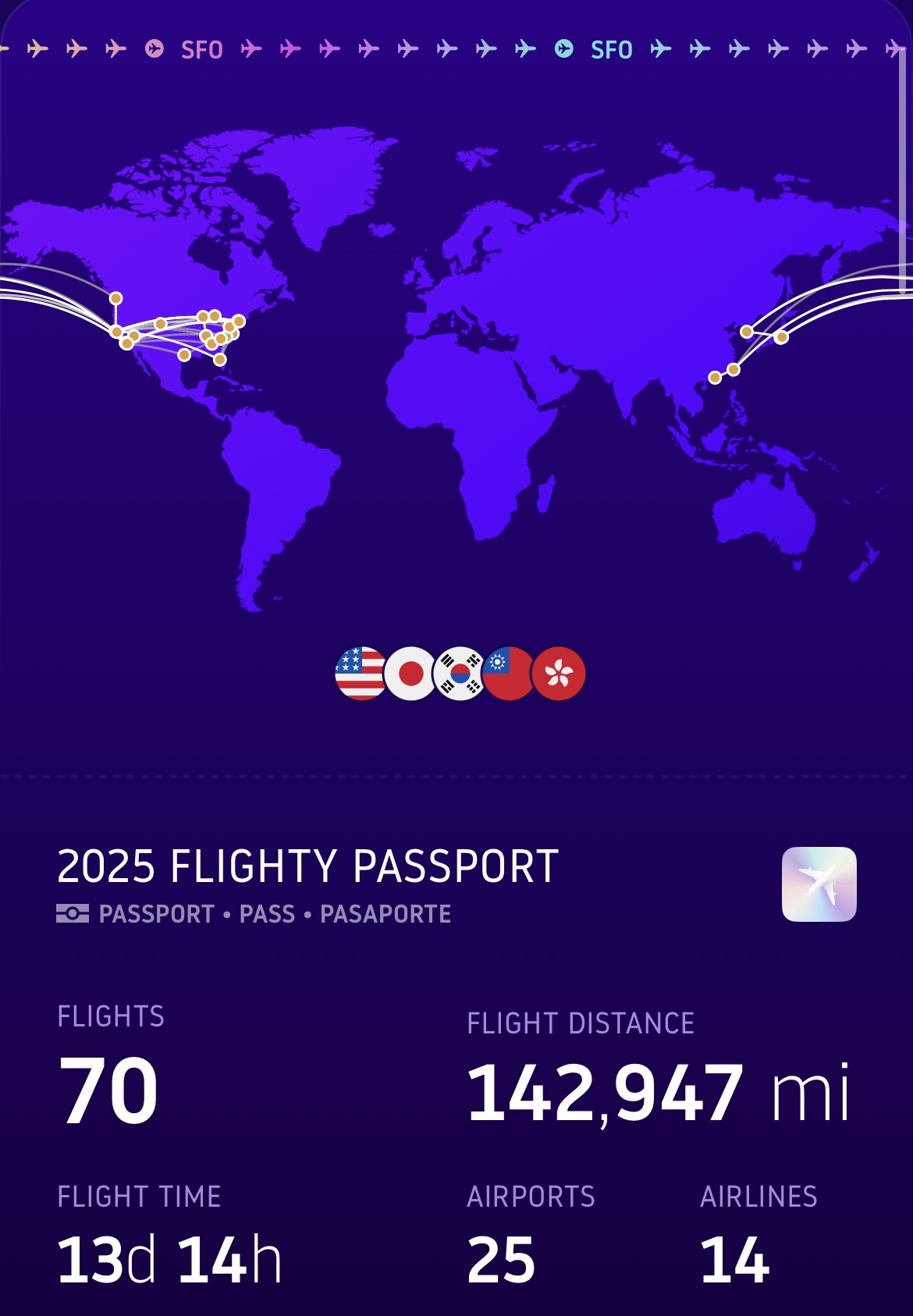
This year marked a plethora of exploring new cities, both domestic and abroad, for work and for pleasure. Places that I had once only read about on Wikipedia or explored via Instagram Reels became real, textured, and alive. I no longer saw America as simply East Coast vs. West Coast, Japan as simply Tokyo, but rather came to appreciate the small bits and pieces that lie in between. What surprised me the most, however, was not the places themselves, but how much they were defined by people.
One of the biggest sources of wealth for me is meeting somebody that I know in every city that I visit because one person is all it takes for a place to go from some random pin on the map to something resembling home. In fact, the older I get, the more I cherish this; when I was in high school I yearned to travel but didn’t have the autonomy to do so. Now that these responsibilities have long passed in the rearview mirror, the adage “you can just do things” is now more true than ever; in fact, it has become my personal responsibility.
At the same time, my world has grown smaller in another way. Not because I value people less, but because I’ve learned how expensive attention and energy have truly become. Over time, I’ve learned to better quantify the qualities of people I spend a lot of time with. I’ve noticed myself gravitating towards people who each can teach me something different about how they live: those that lead with integrity no matter the circumstance, those who fight tooth and nail to get what they want even though the world tells them that it is impossible, those who know that life isn’t meant to be taken so seriously, and those who simply show up for the joy of it. Just as importantly, I’ve learned to recognize relationships that quietly drain rather than nourish. This was something I never quite understood under my old philosophy of “try to get to know everyone.”
One lesson stood out above the rest: the importance of checking on those whom you care about simply cannot be overstated. Nobody wants to make the first move, but everyone appreciates it when someone does. During difficult moments this year, it was hard for me to open up at times, but nevertheless I knew enough to call someone and be present. For me, that alone was enough to begin healing.
Finally, I am blessed to have a few friends in particular who have pushed me to grow intellectually and spiritually in ways that I had not expected at all this year, and to that I am incredibly grateful (you know who you are). Our conversations challenged assumptions I didn’t even realize I held, and they’ve helped me grow in ways that continue to ripple outwards. We’ve managed to push each other to new heights and I look forward to this being a continuing trend throughout 2026 and beyond.
Stephen Colbert, in his commencement speech at Northwestern University, captures my philosophy on relationships quite aptly:
“If we should serve others, and together serve some common goal or idea for any one of you, what is that idea and who are those people? In my experience, you will truly serve only what you love because service is love made visible. If you love your friends you will serve your friends. If you love community you will serve your community. If you love money you will serve your money and if you love only yourself you will serve only yourself and you will have only yourself. So no winning, instead, try to love others and serve others and hopefully find others that love and serve you in return.”
And that’s what it takes to build up a community. To everyone in Cali, homies in Tokyo & Taiwan, and Stanford friends in NYC — thanks for making this world feel simultaneously smaller yet infinitely richer.
Conviction
When I returned from Taiwan back to the states at the beginning of the year, I was very lost. I had just taken a leave of absence from my Masters’ program, a result of me realizing that I was not excited about the problems that I was solving previously both in school and at work. At the same time, I felt immense peer pressure from family and friends to settle down and get a “real job.” This mirrored an earlier chapter of my life, when I was expected to pursue finance on the East Coast, trading my curiosity for security and a high salary. Even after two summers in finance, I still couldn’t tell you the difference between macro/microeconomics, read a supply/demand curve, or explain a Sharpe Ratio. That should have been the clearest signal possible.
Ultimately, in midst of that uncertainty, 2025 became the year of finishing up my degree. I treated it as the last chance to fully immerse myself in structured learning. Research and teaching in autonomous robotics became my main focus; in spite of all the chaos, I found clarity.
It turns out that conviction is less about confidence and more about refusal. Refusing paths that look impressive but feel hollow. Refusing timelines that aren’t mine. Refusing to optimize for safety and risk reduction when I know that I might regret it later.
Working on something that I am truly convicted in requires a certain level of bravery to say no to anything that could potentially be a distraction, which is something I’ve been pretty terrible at in the past. There were moments where I felt tempted to conform to what I thought was expected of a Stanford graduate. There were moments I wondered whether I should drop out entirely to pursue an idea without distraction. I was raised to minimize risk, but that philosophy fundamentally contradicts who I am. Looking back, I recognize many moments in college where I avoided greater risk even though the upside could have been enormous, and I am determined not to repeat that mistake.
The consensus that emerged after this year is that I do my best work at the intersection of aerospace, autonomous robotics, and machine learning. All of this will be for the same overarching goal I’ve had since I was a kid: to make humankind an interplanetary species.
Research
Aerospace is full of unsolved problems, but one of the most fundamental and interesting is deceptively simple: what does autonomy actually mean in an aerospace context?
Many in the industry remain skeptical, and for good reason: those who lived through the era of brittle, rule-based heuristics won’t easily trust autonomy. At the same time, blind faith in AGI — similar to the consensus held in San Francisco — is especially dangerous when considering safety-critical systems.
What might the future of space exploration look like as we develop better heuristics for autonomy? My conviction is in safe, interpretable autonomy where humans remain high-level task architects. This approach offers a path towards systems that we can easily understand, robust, and capable of operating in environments far too distant or dangerous for humans. Human-rated spaceflight continues to be costly and infeasible at scale, so robotic explorers that are far more autonomous than anything we have today will be our first true window into the rest of the cosmos.
While the general hype around Transformers and LLMs is exciting, they are nowhere near sufficient for these challenges. In the next year, there are a few key areas for autonomy in aerospace that I’ll be working on:
- State estimation and causal reasoning in partially observable, safety-critical systems. Latent failures, delayed effects, and sparse telemetry present significant challenges for classical model-based approaches and purely data-driven methods.
- Task-conditioned perception heuristics that better leverage geometry and physical priors. This affords stronger semantic understanding (e.g. depth, segmentation, affordances) at a fraction of the compute cost compared to general-purpose VLMs.
- Models that utilize learned dynamics constrained by physical laws. This enables robust planning and control in highly uncertain environments where analytical models are largely incomplete.
The longer I work on autonomy in aerospace, the more convinced I am that intelligence without environment-grounded interpretability is just scale masquerading as progress.
If you know of anyone working on these problems, please introduce me to them; I’d love to chat.
I don’t know exactly where this path leads, but for the first time in a while, I trust the direction. If this year taught me anything, it’s that serendipity isn’t accidental. It’s something you earn by choosing deeply, showing up fully, saying no when it matters, and creating space for the right people and problems to find you.
That has made the world feel smaller in the best possible way.