by Brian Wu
Snowpiercer
Date: 2026-05-08
Snowpiercer ・ 설국열차 ・ 雪國列車: what's left moving when everything else has stopped.
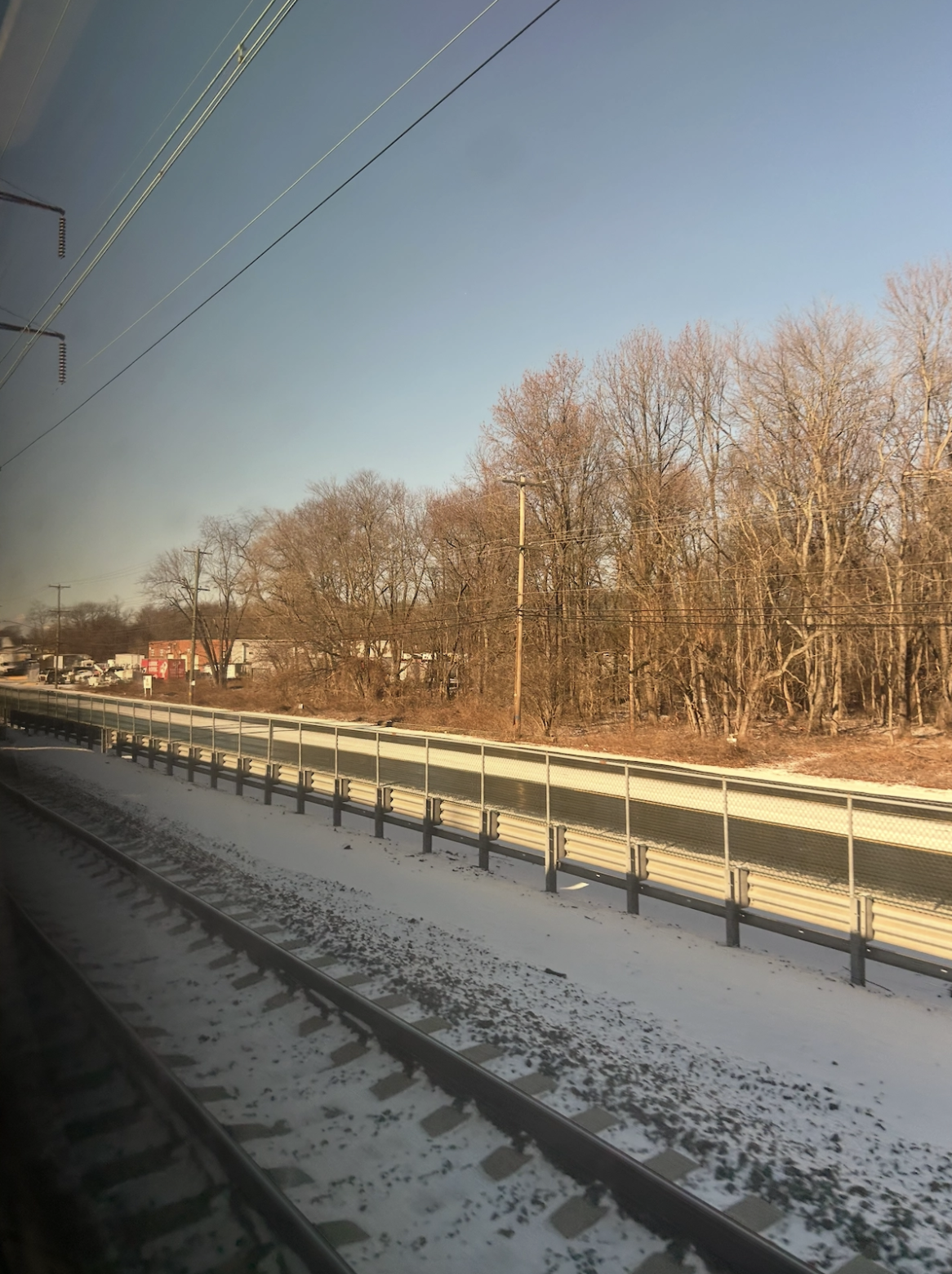
The first photograph I took on my phone in 2026 is relatively unremarkable: a window streaked with grime from decades of derelict, the smear of a snow-blanketed field, the blur of the railroad ties as we thundered south. Just mere hours after some friends and I rang in the New Year plastered out of our minds in a Koreatown club, I was on my way to Philly to meet with a mentor of mine who had flown in from Korea for a conference.
The eastern seaboard had been buried for weeks under this glimmering white powder, a testament to one of the most brutal winters we had been through in recent memory. Through the scratched glass, Central New Jersey looked entirely unrecognizable, like somewhere else entirely — Hokkaido, perhaps?
On the tray table, my computer was open to a post on a Taiwanese backpacking forum, sloppily translated courtesy of Google, written more than a decade earlier by an unnamed stranger. The post was about a man on a journey with no destination in mind: traveling across the Japanese countryside in the middle of winter by train, he searched for someone he had once loved when he was eighteen, yet arrived too late to find her. I was about a third of the way through when I noticed that the snow out the window had become more interesting than the snow on the screen. I looked up, and the unnamed stranger's window began to overlap with mine.
…
High school for me was fairly tough, and all I can say is that I'm grateful to have survived that experience. Back then, I searched for meaning and comfort through music; this journey brought me back to BTS often due to the sheer amount of emotional honesty and hidden narratives they interject throughout their music. Spring Day came out during my Junior Year of high school in 2017, and while the meaning is up for interpretation, it’s generally understood to be a song BTS wrote in part for the families of the 2014 Sewol ferry victims, asking how long winter has to last before spring arrives. At the time, I couldn't speak Korean, so I ruthlessly dissected the lyrics in the Japanese version of the song instead. As I watched those fields give away to the suburbs, and finally the skyscrapers of Philly, a verse from this song that I had been carrying since I was sixteen surfaced.
まるで冬のようさ 夏でも吹雪くようさ
It feels just like winter, as if a blizzard was raging even in the summer心を乗せた列車 すでに雪の中
A train that carries my heart, it's already deep within the snowいっそ君と地球の裏側へ 手を掴んでもう 逃げたい
I wish I could take your hand and run away with you all the way to the other side of the worldどれだけ降れば春の日が来るのだろう
Just how much more must it snow before a spring day arrives?
Of course, at the time my naïveté prevented me from thinking much of it then on the way to Philadelphia.
But maybe that was a sign from above. I was stuck on the train, yet you were already starting to drift. Somewhere in me, the verse knew it before I did.
Act 1:
There is a kind of winter that refuses to stay within its season. It slips into the chest and stays there, indifferent to the weather outside, indifferent to what month the page on the calendar says. I can find myself standing in May light, in a city that had been blooming for weeks, yet continue to feel the snow somewhere behind my sternum.
On a Monday last week, I walked the few blocks to my regular coffee shop. The trees on my block had finally bloomed, and the sun was warm enough that I had ripped off my jacket off by the time I got there. Sitting at the window, halfway through the cup, I caught myself holding it with both hands the way you do in February, when the warmth in a cup is the only warmth around. The trees outside were doing their part, but the cup in my hands had its own ideas. The body keeps its own weather.
Act 2:
The heart that had been loaded onto the train knew something that I didn't. It's in motion, speeding past the platform with such force the wind almost knocks you off your feet, committed to a journey that it didn't quite agree to. Just like that, it began to move without you.
In Bong Joon-ho's 2013 film, humanity's last survivors live aboard Snowpiercer, a train that perpetually circles the frozen Earth, its passengers divided by class from tail car to engine and kept in motion by a sacred mechanism they worship as the Engine Eternal. The Engine Eternal is truly powerful. It overrides all reason, all forms of intuition and sensibility that we know. With it, the Snowpiercer relentlessly thunders around the globe, refusing to slow down even just a tiny bit. For a moment, I ran in a daze powered by the Engine Eternal. Weekends I could salvage, a drive I would make, a city I would visit, a calendar I would ask to slow. Yet it never slowed. And thus, I continued to trudge onwards without a destination in sight.
너무 야속한 시간
Time is so cruel and unforgiving나는 우리가 밉다
I hate us —이제 얼굴 한 번 보는 것 조차 힘들어진 우리가
us who found it so hard to see each other even for once
Time was the cruelest, more than either of us was to each other.
The blog post on my computer had no narrator other than our unnamed stranger. It's a personal account, as raw as it can get, written years later about something that happened when he was eighteen. That year, while saving money working at a karaoke bar in Tainan, he crossed paths with a Japanese backpacker named Ami (アミ/亜美) who was looking for work after losing her wallet. Our unnamed stranger was hesitant, but over time, he couldn't help but fall in love. Ami was an artist, and had a rare type of lightness to her personality that I struggle to find in many people. During that summer, he showed her around Taiwan; at a lantern festival in Shih-Fen, she left him a postcard where she told him to tell her his dream when he found it, and to come find her once they had each become the person that they had wanted to be. Then, she returned to Japan, leaving without explanation.
A decade later, this blog post would turn into the Japanese-Taiwanese collaboration film (青春18X2:君へと続く道), and I would watch it for the first time on a flight between Newark and San Francisco in 2024. 青春18 (Seishun 18) is a train ticket in Japan that you can only buy at certain times of the year such as school breaks that, for a period of 5 days, allows unlimited travel on all local train services across the Japan Rail network. This name also alludes to youth, the age when you don't yet know how anything is going to end. Our unnamed stranger, who we now know is named Jimmy, is 36 — twice eighteen, twice the age of the kid he was — when he finds out that he is fired from the company he co-founded, and thus heads back to his parents' house in southern Taiwan. It is here where Ami's postcard resurfaces, and almost immediately, Jimmy finds himself on a train heading North: Tokyo, Kamakura, Nagano, Niigata, and finally Fukushima. In every car, a stranger triggers a memory back to that summer in Tainan: a student backpacker who convinces Jimmy to stop in a snowing Nagaoka. An izakaya owner in Matsumoto from Jimmy's hometown in Taiwan. A woman at a PC cafe who drives Jimmy to a Japanese lantern festival because he and Ami had released a lantern filled with their wishes eighteen years prior. Yet, we begin to see a growing contrast between Japan and Taiwan as Jimmy approaches Ami's hometown of Tadami. Taiwan is full of warm images: the tropical summer heat, colors of a mural, a Mayday song blasting on the radio. Japan, on the other hand, is blue and cold. You feel extremely alone just by watching those scenes.
The present, you realize, is just the past returning in slow motion. By the time Jimmy reaches the address on the postcard, he already knows. Ami had passed away shortly after her return to Japan. He had been carrying her death within the success of his career without realizing it. Now that success is gone, too, and Jimmy is what's left moving when everything else has stopped.
Yet what the film refuses to do is to let the present know what the past truly meant until the present arrives. At eighteen, Jimmy certainly doesn't know he's having the most formative encounter of his life. In his mind, he's visualizing a slow several weeks at the karaoke bar, a girl he likes but can't keep, a goodbye that somewhat hurts but in a manageable way. Ami only becomes Ami later; by the time her absence announces what it has always meant to Jimmy, she has already disappeared past the platform and into the snow.
I had just recently turned twenty-four on the day I set out on that train. Now, with the Japanese version of Spring Day looping in my head, I could see you drifting. I was already starting to suspect that some retrospective version of myself in the future was going to look back at those weeks as something I had been inside without recognizing.
…
A few weeks ago, my Yale friend Ethan and I crossed paths in Boston where we were both visiting for work. In the backseat of Jerry's Nissan Altima, we roamed around the city, all three of us aiming to search for what this chapter of our lives meant. I don't remember much from the conversation, but one idea all three of us surprisingly agreed on was that a relationship with all variables held constant except the timing will look like a completely different relationship depending on which timing you choose. The right timing, as it seems, can only be known in retrospect. Indeed, everything seems to make sense in retrospect.
What I think Ethan meant was that the version of us where everything might have worked out existed in a configuration that was never reachable. Maybe, just maybe, if there was just a few more years of slack in the calendar, if we didn't have to cross a continent, if we didn't have to stack jobs upon other jobs, we might have stayed. Or we might not. All that is to say that the possibility lived purely within a timing that we did not have; just like how the version of Jimmy and Ami that worked lived in a timing they did not have.
Perhaps there is no villain. There is just the calendar instead.
Act 3:
Not long after the train ride, we found ourselves a continent over, standing at the edge of the world. The wind nearly knocked us off balance. You grabbed my hand and ran toward the ocean, and for a moment, nothing in the world could touch us. The ocean did its thing. The light did its thing. There was nothing in front of us but water, and more water as far as the eye could see. For just that night, the promise from the opening verse of Spring Day rang true.
いっそ君と地球の裏側へ 手を掴んでもう 逃げたい
I wish I could take your hand and run away with you all the way to the other side of the world
We had run as far as the country allowed, and the continent ended at our feet.
…
Right before this line, the Korean version of the song paints the picture of a single train, alone on its track, rumbling through an eternal winter.
여긴 온통 겨울 뿐이야
It's nothing but winter here8월에도 겨울이 와
Even in August, winter comes
(a reference to "Christmas in August, 1998")마음은 시간을 달려가네
My heart leaps through time
(a reference to "The Girl Who Leapt Through Time, 2006")홀로 남은 雪國列車
The lone remaining Snowpiercer
You are alone first. Then you take the hand. Then you go. And for that moment in time, the loneliness is suspended; the train still moves, but it moves with both of us on it now, and the snow outside becomes scenery rather than climate.
この大空を舞う粉雪のよう 粉雪のよう
Like the powdery snow dancing across this wide sky, like the powdery snow날리는 눈이 나라면
If I was a fluttering snowflake조금 더 빨리 네게 닿을 수 있을 텐데
Maybe I could have reached you a little sooner, but…
Later on, there is another verse about being a fine drift of snow in a wide sky, about how if we were fluttering snowflakes, we could reach the other faster. The cruelty of that image is that it presumes distance. Here, at the end of the world, there was none. We had finally made it to the same square foot of country.
But trains don't stop. By March, we were still in this city, yet somehow further apart than we had been on opposite sides of the continent. Geography was never really the obstacle; the timing simply took over, the way it always does. The fine snow keeps on drifting. It just doesn't land.
I do not know, even now, what changed. I know I promised to come back one day, yet I didn't. I know you were struggling with things I couldn't see. I know I told myself, for awhile, that you had changed.
But in reality, who had changed?
The answer lands on both of us. The only way to grieve a silent departure is is to choose between resenting them and forgetting them, knowing that resentment is always going to cost more.
니가 변한 건지
Is it you who changed?아니면 내가 변한 건지
Or perhaps I was the one who changed?이 순간 흐르는 시간조차 미워
I hate even the time passing by at this moment우리가 변한 거지 뭐
I guess we're the ones who changed모두가 그런 거지 뭐
I guess everyone has changed그래 밉다 니가
Yes, I hate you넌 떠났지만
And even though you left, but…단 하루도 너를 잊은 적이 없었지 난
I never forgot about you for a single day솔직히 보고 싶은데
To be honest, I miss you이만 너를 지울게
But I'll let you go now그게 널 원망하기보단 덜 아프니까
Because that hurts less than blaming you
I haven't chosen. I'm just writing this instead.
Act 4:
It's currently three in the morning in early May, and once again, my questions continue to keep me awake. If we know that seasons must always exist in cycles, and that winter is always going to be followed by spring, then how much more must it snow before a spring day comes?
I had been holding on that that question for months. But perhaps some questions aren't meant to be answered. They're just there for keeping you company through the season they describe.
I found solace in the fact that Snowpiercer never resolved cleanly either. The world outside is a desolate, seemingly uninhabitable winter. The train is all that there is left. The choice of whether to break out into the snow or stay onboard is given, finally, to the passengers. Every reading of the ending is an interpretation of what the reader thinks survival is for. I am not sure what I think yet.
…
Spring Day closes in a quiet and subtle manner. The chorus used to ask how long someone must wait, how many freezing nights they must endure before they get to see the other person again. Yet by the final verse, the question flips. The speaker no longer counts those freezing nights. They start running, telling whoever is on the other side to just hold on a little longer, thus declaring the intent to close the physical and metaphorical distance themselves.
どれほど想えば 凍える夜数えれば
How deeply must I yearn? How many freezing nights must I count?ねぇ、会えるの?
To be able to see you?…
조금만 기다리면
If you just wait a little while…며칠 밤만 더 새우면
For just a few more sleepless nights…만나러 갈게
I'll come to see you
And just like that, we shift from endurance to motion. For waiting through nights to walking into them. While the waiting might have felt like a kind of paralyzing winter, the walking is a kind of spring.
I don't think that Spring Day promises a literal reunion. Rather, it argues that we have just ceased to be mere passengers on the train. The train was always going to keep moving. The question was whether you were going to keep being moved.
The train that I was on that morning is still running its route somewhere between Boston and Washington DC. The Northeast Regional doesn't care that the year has turned. Somewhere, right now, someone else is on it, watching their own snow go past, having their own verses surface unbidden, not yet knowing that they are living in a frame older than they are. The train pierces forward. It always has. The question is whether you are alone on it, or whether you are, for some stretch of the journey, going somewhere with someone — and whether, when you find yourself alone again, you remember that the journey was real.
By every external measure, spring has come. The towering trees in my city are unconcerned with my chest; they do their work as I walk past them on my coffee run every morning. Yet, my heart feels like it was left behind in late February, the part of winter where you can almost believe it might end but cannot yet feel it. I don't know if we'll see each other again. I don't know if we're supposed to. What I know is that I am writing this in Spring about a moment in Winter, which is the only direction in which these things resolve. The right timing only ever announces itself in retrospect. Everything should make sense looking back, and that's why I'm looking back today.
It's currently May, yet it does not feel like Spring has come yet.
But I choose to no longer wait. And so I write.